Islamabad — A new chapter in Pakistan’s climate response opened this week as Islamic Help UK joined hands with WWF-Pakistan to launch the country’s most ambitious faith-based environmental programme: the Al Mizan Forest. Under a three-year agreement signed at the WWF office in Islamabad, the two organisations will plant more than 2.7 million trees across approximately 1,700 hectares in Gilgit-Baltistan, Khyber Pakhtunkhwa, and Punjab.
The initiative draws its name from the Qur’anic concept of Mizan — balance — and represents the first time in Pakistan that a major international Islamic charity has formally partnered with a leading conservation organisation to tackle climate change at scale.
What is the Al Mizan Forest Programme?
The programme is part of the global Trillion Trees initiative, which aims to restore, conserve, and protect one trillion trees worldwide by 2050. However, project leaders emphasise that Al Mizan goes well beyond planting trees.
Rather than focusing solely on tree counts, the initiative integrates:
- Holistic ecosystem restoration — restoring native habitats and biodiversity
- Sustainable livelihoods — agroforestry systems that support local farmers
- Community resilience — protecting vulnerable communities from climate impacts
- Faith-informed education — translating Islamic environmental values into practical conservation
How the Partnership Will Work
Under the agreement (2026–2029), the two partners bring complementary strengths to the table:
WWF-Pakistan serves as the lead implementation partner, contributing decades of conservation science, planning expertise, and on-ground execution capability. The organisation has long-standing experience in afforestation, wildlife corridor design, and habitat connectivity across Pakistan.
Islamic Help UK will mobilise international funding, lead awareness campaigns, and deliver values-driven educational programmes. The charity sees the partnership as a way to translate the Islamic principle of environmental stewardship — khilafah — into measurable action.
Why Gilgit-Baltistan, KP, and Punjab?
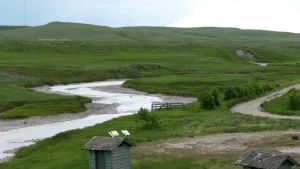
The three target provinces face distinct but interconnected climate challenges. Gilgit-Baltistan is among Pakistan’s most climate-vulnerable regions, hosting some of the largest glacier systems outside the polar regions. Rapid glacial melt is altering water availability, increasing the risk of glacial lake outburst floods, and straining local communities.
Khyber Pakhtunkhwa has seen significant deforestation pressure and water-cycle disruption, while Punjab — Pakistan’s agricultural heartland — faces growing soil degradation and heatwave intensification.
Integrated Programme Features
The Al Mizan Forest will incorporate several innovative components rarely combined in a single Pakistani conservation initiative:
- Green Waqf — an Islamic endowment model providing sustainable financing for environmental protection
- Conservation zoning using traditional Ḥima and Ḥarīm principles (Islamic land-protection concepts)
- Wildlife corridors connecting fragmented habitats to support biodiversity recovery
- Water recharge systems for aquifer restoration
- Community education through schools, mosques, and youth programmes
Voices from the Partnership
Kamran Shezad, Advisor for Climate Action at Islamic Help UK, called climate change “one of the defining challenges of our time” and said faith communities have a crucial role to play. “Through the Al Mizan framework, we are reconnecting environmental responsibility with values of balance, stewardship, and collective action.”
Rab Nawaz, Senior Director of Conservation Programme at WWF-Pakistan, noted that the collaboration “introduces a complementary dimension by strengthening outreach and community participation, enabling us to expand the impact of conservation efforts across Pakistan.”
Shaykh Sultan Niaz ul Hassan, Founder of Islamic Help UK, emphasised the partnership’s vision: “At Islamic Help, we believe that environmental responsibility is a shared human duty. Through initiatives like Al Mizan, we aim to translate values into practical action.”
Maulana Attaullah Shahab, a senior leader from Gilgit-Baltistan and former member of the Gilgit-Baltistan Council, called the partnership “timely and important” for a region already experiencing dramatic climate impacts. “Gilgit-Baltistan is directly experiencing the impacts of climate change — melting glaciers, changing water flows, and increasing pressure on natural systems.”
Broader Significance
The initiative draws inspiration from “Al-Mizan – A Covenant for the Earth”, a UNEP-supported Islamic environmental declaration released in 2024. Programme leaders say the model is designed to be replicable globally, particularly in Muslim-majority countries facing severe climate stress.
By bridging scientific conservation expertise with faith-based community mobilisation, the Al Mizan Forest Programme offers a potential template for collaborative climate action that other countries — and other faith communities — could adapt.
What Comes Next
Implementation will begin in early 2026, with site identification, nursery establishment, and community engagement preceding large-scale planting. The partners will also launch youth volunteer programmes and educational campaigns alongside the physical restoration work.
For Pakistan — a country that contributes less than 1% of global emissions but ranks among the most climate-vulnerable nations on Earth — initiatives like Al Mizan represent a critical scaling up of community-rooted climate action.
Media Contacts
Islamic Help UK — Syed Ijaz Humdani, Country Coordinator, Climate Action Program for Pakistan
Email: [email protected]
Phone: +92 332 308 55222
WWF-Pakistan — Muhammad Ibrahim Khan
Email: [email protected]
Phone: +92 342 5196235
Related Stories


- Marriage Fraud Alert ||February 13, 2024