Gilgit-Baltistan Final Electoral Roll 2026 Released: 963,034 Voters Registered Across 24 Constituencies — A 29% Surge Since 2020
Gilgit — The Election Commission of Gilgit-Baltistan (ECGB) has released the Final Electoral Roll 2026, officially confirming 963,034 registered voters across the region’s 24 directly elected constituencies. The figure marks a 29.2% increase over the 745,362 voters who were eligible to cast ballots in the last general election in November 2020 — a sharp expansion that will reshape constituency-level competition when polling takes place on June 7, 2026.
The final list, displayed at all designated voter facilitation centres and uploaded to the ECGB website, breaks down to 506,097 male voters (52.55%) and 456,937 female voters (47.45%). The gender gap — historically a defining weakness of GB’s electoral inclusion — has narrowed significantly: from a 19.1% male-female differential in 2020 to just 10.8% in 2026.
Constituency-Wise Voter Breakdown — All 24 Seats
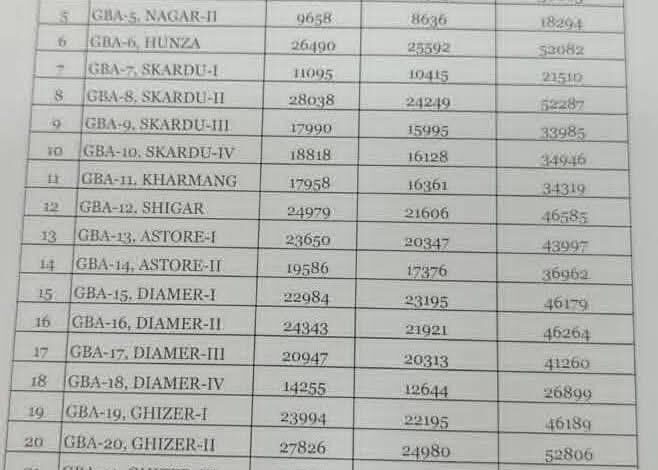
Below is the complete constituency-wise voter list as confirmed in the ECGB’s Final Electoral Roll 2026:
| # | Constituency | Male Voters | Female Voters | Total Voters |
|---|---|---|---|---|
| 1 | GBA-1 Gilgit-I | 26,359 | 22,656 | 49,015 |
| 2 | GBA-2 Gilgit-II | 30,015 | 26,181 | 56,196 |
| 3 | GBA-3 Gilgit-III | 27,571 | 25,048 | 52,619 |
| 4 | GBA-4 Nagar-I | 15,758 | 14,305 | 30,063 |
| 5 | GBA-5 Nagar-II | 9,658 | 8,636 | 18,294 |
| 6 | GBA-6 Hunza | 26,490 | 25,592 | 52,082 |
| 7 | GBA-7 Skardu-I | 11,095 | 10,415 | 21,510 |
| 8 | GBA-8 Skardu-II | 28,038 | 24,249 | 52,287 |
| 9 | GBA-9 Skardu-III | 17,990 | 15,995 | 33,985 |
| 10 | GBA-10 Skardu-IV | 18,818 | 16,128 | 34,946 |
| 11 | GBA-11 Kharmang | 17,958 | 16,361 | 34,319 |
| 12 | GBA-12 Shigar | 24,979 | 21,606 | 46,585 |
| 13 | GBA-13 Astore-I | 23,650 | 20,347 | 43,997 |
| 14 | GBA-14 Astore-II | 19,586 | 17,376 | 36,962 |
| 15 | GBA-15 Diamer-I | 22,984 | 23,195 | 46,179 |
| 16 | GBA-16 Diamer-II | 24,343 | 21,921 | 46,264 |
| 17 | GBA-17 Diamer-III | 20,947 | 20,313 | 41,260 |
| 18 | GBA-18 Diamer-IV | 14,255 | 12,644 | 26,899 |
| 19 | GBA-19 Ghizer-I | 23,994 | 22,195 | 46,189 |
| 20 | GBA-20 Ghizer-II | 27,826 | 24,980 | 52,806 |
| 21 | GBA-21 Ghizer-III | 22,881 | 20,258 | 43,139 |
| 22 | GBA-22 Ghanche-I | 19,259 | 17,342 | 36,601 |
| 23 | GBA-23 Ghanche-II | 18,725 | 17,031 | 35,756 |
| 24 | GBA-24 Ghanche-III | 12,918 | 12,163 | 25,081 |
| TOTAL | 506,097 | 456,937 | 963,034 | |
Key Statistics at a Glance
- Largest constituency: GBA-2 Gilgit-II — 56,196 voters
- Smallest constituency: GBA-5 Nagar-II — 18,294 voters
- Difference between largest and smallest: 37,902 voters (3.07× factor)
- Average constituency size: ~40,126 voters
- Female-majority constituency: GBA-15 Diamer-I — the only seat where women voters (23,195) outnumber men (22,984)
- Net increase since 2020: +217,672 voters (+29.2%)
- Male voter growth (2020→2026): +24.8%
- Female voter growth (2020→2026): +34.4% — significantly faster than male growth
District-Level Voter Distribution
Aggregating constituencies into administrative districts reveals where the political weight of the region lies:
| District | Seats | Total Voters | Share of GB |
|---|---|---|---|
| Diamer | 4 | 160,602 | 16.7% |
| Gilgit | 3 | 157,830 | 16.4% |
| Skardu | 4 | 142,728 | 14.8% |
| Ghizer | 3 | 142,134 | 14.8% |
| Ghanche | 3 | 97,438 | 10.1% |
| Astore | 2 | 80,959 | 8.4% |
| Hunza | 1 | 52,082 | 5.4% |
| Nagar | 2 | 48,357 | 5.0% |
| Shigar | 1 | 46,585 | 4.8% |
| Kharmang | 1 | 34,319 | 3.6% |
Diamer emerges as the single most voter-heavy district, narrowly edging Gilgit. Combined, the four high-altitude districts of Diamer, Gilgit, Skardu, and Ghizer account for 62.7% of all GB voters and 14 of the 24 directly elected seats — making them the decisive battleground for any party hoping to form government.
Political Significance: Where the Election Will Be Won
Gilgit District — The Capital Battleground
With 157,830 voters across three seats, Gilgit District is the symbolic and operational heart of the region. GBA-2 Gilgit-II — the single largest constituency in the region at 56,196 voters — is also where PML-N has fielded former Chief Minister Hafeez ur Rehman. Capturing the Gilgit seats is essential for any party making a credible claim to regional government, since these constituencies set the broader media narrative for the rest of the polling day.
Skardu District — Volatile and Pivotal
Skardu’s four seats (142,728 voters) historically swing between parties more readily than other districts. The wide internal variance — GBA-7 Skardu-I has just 21,510 voters versus GBA-8 Skardu-II’s 52,287 — means individual candidate strength can override party brand on tightly contested seats. Skardu is also the seat of Pakistan’s tourism boom, with Skardu International Airport expansion shaping the development discourse.
Diamer District — The Largest Bloc
Diamer’s four seats deliver 160,602 voters, the most of any district. Politically the district leans conservative and is influenced by religious-political networks (JUI-F, Islami Tehreek). Diamer also hosts GBA-15 Diamer-I, the only constituency in GB where women voters now outnumber men — a notable shift attributed to focused NADRA registration drives and women-friendly polling station planning since 2020.
Ghizer District — Education and the Sectarian Mosaic
Ghizer’s three seats (142,134 voters) include GBA-20 Ghizer-II at 52,806 — the second-largest seat in the region. The district has Pakistan’s highest literacy rate among rural areas, and historically delivers tight, multi-party splits between PPP, PTI, PML-N, and independents tied to local Ismaili community institutions.
Hunza, Nagar, Ghanche, Astore, Shigar, Kharmang — The Smaller Battlegrounds
These six districts together control 10 seats. Hunza (52,082) is a single-seat district where high voter turnout and education levels produce decisive mandates. Nagar (48,357) is split between two seats with steep size disparity (GBA-5 has just 18,294 voters). Ghanche, Astore, Shigar, and Kharmang each operate with strong tribal and clan-based voting dynamics where individual candidate identity tends to outweigh party affiliation.
Why the Female Voter Surge Matters
The headline statistic — women voter rolls growing 34.4% versus 24.8% for men — reflects sustained registration drives by the Election Commission, NADRA, and partner civil-society organisations over the past five years. In 2020, only 45.6% of GB voters were women; in 2026, the share has climbed to 47.4%.
The shift is most pronounced in Diamer District, where targeted outreach has erased the male-female gap entirely in GBA-15 (Diamer-I) and substantially narrowed it in the three remaining Diamer seats. This is politically significant: Diamer has historically had the lowest female political participation in the region, often cited as a marker of conservative voting culture.
Possible Impact on the June 7 Election
The expanded electoral roll changes the math of the June 7 polls in three concrete ways:
- Higher turnout volume: Even at the same percentage turnout, the parties will be mobilising roughly 217,000 more voters than in 2020 — requiring more polling staff, transport, and security per constituency.
- Women’s vote becomes a margin-maker: With nearly 457,000 women on the rolls, parties that successfully mobilise female turnout in tight constituencies (Hunza, Ghizer-I, Astore-II, Skardu-IV) could shift outcomes by 1–3 percentage points.
- New voter unpredictability: Approximately one in five voters on the 2026 roll did not exist in the 2020 roll. These newly enrolled — many young, urban, and first-time voters in Gilgit and Skardu — represent the single largest pool of unaffiliated decision-makers in the upcoming poll.
What the ECGB Has Said
The Election Commission of Gilgit-Baltistan has reiterated that the Final Electoral Roll 2026 is now closed for routine additions, though limited corrections may continue under specific provisions until polling day. Voters can confirm registration via ecgb.gov.pk or by SMS using their CNIC number.
Polling for the 2026 Gilgit-Baltistan Assembly election is scheduled for June 7, followed by local government polls on June 14.
Conclusion
The release of the Final Electoral Roll 2026 marks the most consequential numerical baseline of the GB electoral cycle. The 29% expansion of the voter base — driven disproportionately by women — alters constituency-level math, raises the operational stakes for the ECGB, and arguably reshapes the strategic calculations of every contesting party. With less than three weeks to polling day, the parties that have built credible mobilisation networks in the largest constituencies — Gilgit-II, Ghizer-II, Gilgit-III, Skardu-II, Hunza — are best positioned to convert the new voter pool into seats.
Nai Khabar will continue to track candidate filings, campaign developments, and polling-day results through to the final declaration of the next Gilgit-Baltistan Legislative Assembly.
Related Coverage on Nai Khabar
External references: Election Commission of Gilgit-Baltistan · 2026 GB Assembly Election (Wikipedia) · PakVoter 2020 baseline
Related Stories


 Supreme Court Upholds the Practice and Procedure Act as LegalOctober 12, 2023