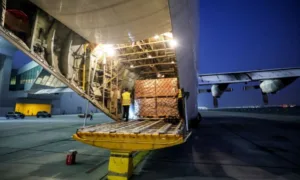
US Sends Warships in Response to Israel-Hamas Conflict

US Sends Warships in Response to Israel-Hamas Conflict — full coverage and analysis on Nai Khabar. Below we break down the key facts and what this development means.
WASHINGTON: In the heart of the Middle East, the ongoing conflict between Israel and Hamas has taken a dangerous turn, drawing international attention and raising fears of impending escalation.
The deployment of US warships in the region clearly indicates the seriousness of the situation as violence on the ground continues to increase. This crisis has important geopolitical implications given the specter of a larger conflict and growing fears of Iranian involvement. As the conflict continues, the humanitarian crisis in Gaza is worsening, further complicating the situation.
Causes of the conflict
The recent escalation of the long-standing conflict between Israel and Hamas has its roots in a series of events that have led to tensions between the two sides. The situation began with protests in East Jerusalem against the possible displacement of Palestinian families. In response, Israeli security forces cracked down on the protests, causing casualties and inflaming tempers. This early unrest paved the way for Hamas, the Palestinian militant group that controls the Gaza Strip, to launch rocket attacks on Israel, resulting in a disproportionate and devastating response.
UNRWA
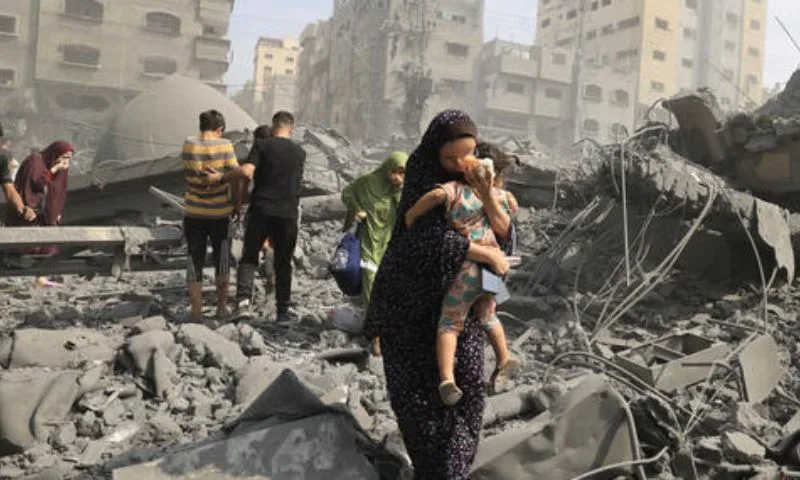
Israel responded with a ruthless bombing campaign on Gaza, causing significant civilian casualties and plunging the region into a severe humanitarian crisis. The conflict began eight days ago and the results are alarming. Around 1,300 Israelis, mostly civilians were killed by Hamas rocket fire. On the Gaza side, authorities report more than 2,670 deaths, 25% of them children, which is alarming. These grim figures are expected to rise as Israel prepares for a possible ground attack on the densely populated Gaza Strip.
Escalation and the spectre of Iran
The situation on the ground is worrying and concerns about a possible escalation are growing. Senior US officials, including White House National Security Adviser Jake Sullivan, have expressed these concerns, highlighting the risk of a wider conflict and possible Iranian involvement.
To underscore the United States’ commitment to preventing further escalation, US Secretary of Defense Lloyd Austin announced the deployment of a second aircraft carrier group. This is seen as a strong signal of U.S. resolve in the region and reflects the country’s determination to deter any state or non-state actor that might attempt to escalate the conflict.
The aircraft carrier Dwight Eisenhower will join an existing fleet that already includes the giant aircraft carrier Gerald R. Ford based in the Eastern Mediterranean. These carriers are not alone; They are accompanied by warships and attack aircraft, demonstrating the urgent need to prevent the situation from escalating into a broader regional crisis.
Iran, a major regional player and strong supporter of Palestinian causes, is a key factor in the conflict. A US official described Iran as “the elephant in the room,” citing its growing military presence in the region. Iranian Foreign Minister Hossein Amirabdollahian has warned that his country could take action if Israeli atrocities in Gaza continue. He reported that Iran had sent a message to Israeli officials warning: “If they do not stop their
atrocities in Gaza, Iran cannot simply remain a spectator.” Amirabdollahian also warned that a prolonged war would particularly harm the United States and could cause significant damage to states.
Tensions on the Northern Front
The escalation of the conflict is not limited to the Gaza Strip. Violence is spreading rapidly along Israel’s northern border. Iran-backed Hezbollah fighters in Lebanon carry out attacks on Israeli army positions and a village on the northern border. In response, Israel carried out retaliatory attacks in Lebanon, raising fears of further destabilization in the region.
U.S. Diplomatic Efforts
Faced with a rapidly evolving crisis, the United States is actively engaging in diplomatic efforts. The US government is calling on Israel to postpone its ground offensive and provide humanitarian aid to Gazans stranded in the conflict zone.
Palestinian, President, Travel, Gaza, Antony Blinken, Mahmoud Abbas, United States, Israel, Jordan, Amman, Israel, Nakba, Airstrikes, American, Gaza Strip, King Abdullah II, Hamas
The discussions included reflections on new and improved weapons packages for Israel and Ukraine. President Joe Biden plans to hold an intensive debate on the issue with the US Congress next week. This comes as the House of Representatives grapples with Republicans fighting to elect a new president, complicating the legislative process.
In response to these challenges, Senate Majority Leader Chuck Schumer has indicated that the US Senate could take the lead in approving additional funding for Israel, bypassing the ongoing confusion in the House of Representatives.
Republican Senator Lindsey Graham, a strong supporter of close US-Israel ties, has announced plans to travel to the region with other senators.
The Humanitarian Crisis and the Commitment of the United States.
As the conflict worsens, the United States is also actively mobilizing to resolve the problem. the growing humanitarian crisis in the Gas Strip.
The United States is urging Israel to postpone any action on the ground to allow humanitarian efforts to continue. While the United States does not interfere in Israeli military planning, it emphasizes that any actions taken must be consistent with the laws of war to ensure that civilians have a real chance of safety.
US Secretary of State Antony Blinken announced on Sunday the reopening of the Egyptian-controlled border crossing into Gaza.
However, challenges remain as it is difficult for U.S. citizens and others to leave the region. Sullivan expressed his determination to ensure that civilians remaining in Gaza have access to basic needs such as food, water and safe shelter. In an interview with CNN, he mentioned that Israeli officials had recently “restored water supplies in southern Gaza,” underscoring the importance of maintaining basic services.
Related Stories on Nai Khabar
Related Stories
 Bangladesh to Clear Energy Bills Ahead of ElectionJuly 29, 2023
 Besieged Palestinians Await Aid as Israel Pounds GazaOctober 20, 2023